
Quick answer
For most lawns, a corded 2-in-1 dethatcher/scarifier is the best value. Our top pick is the WEN DT1516 (16″ path, 15 A motor, 5 depth settings, both reels included). On lawns over about half an acre, pull an Agri-Fab 48″ tow-behind with your riding mower instead. Only dethatch when the thatch layer is thicker than about ½ inch.
Thatch is the spongy layer of dead stems and roots between the grass blades and the soil. A thin layer is healthy. Once it passes about half an inch, it blocks water, air and fertilizer and makes the lawn feel springy and patchy. A dethatcher combs that layer out. Here are the best ones for every lawn size, followed by when and how to use them without wrecking your grass.
| 1 |  | WEN DT1516Best Overall | Check price |
| 2 | 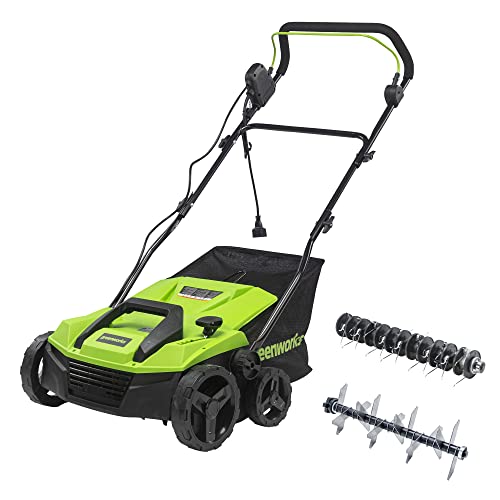 | Greenworks 14″ 13 A Dethatcher/ScarifierBest Value | Check price |
| 3 |  | Sun Joe AJ805E 15″Best for Easy Cleanup | Check price |
| 4 |  | Sun Joe 24V-X2-DTS15Best Cordless | Check price |
| 5 |  | EGO Power+ DA1400 AttachmentBest for EGO Owners | Check price |
| 6 | 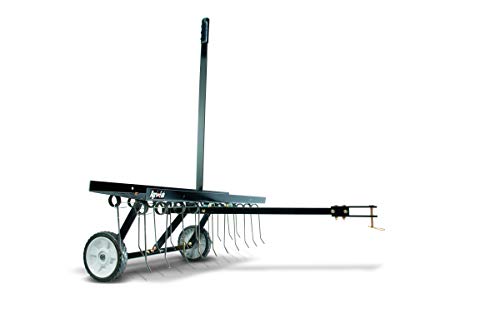 | Agri-Fab 45-0295 48″ Tow-BehindBest for Large Lawns | Check price |
| 7 |  | Brinly 48″ Tow-BehindBest Heavy-Duty Tow Model | Check price |
| 8 |  | Walensee 15″ Thatch RakeBest Manual Option | Check price |
The best lawn dethatchers
1WEN DT1516Best Overall
WEN’s DT1516 has the widest path (16″) and the strongest motor (15 A, up to 3,300 RPM) of the popular corded models. It comes with both heads: a 24-tine spring-steel dethatching reel for yearly cleanups and a 20-blade scarifying reel for heavy thatch or prepping to overseed. Five height settings run from +¼″ (just combing) to −½″ (into the soil).
- Power: 15 A corded, up to 3,300 RPM
- Width: 16″
- Reels: 24-tine dethatcher + 20-blade scarifier
- Depth: 5 positions, +¼″ to −½″
- Extras: collection bag, overload shutoff, 2-year warranty
Best For: Most suburban lawns up to about ½ acre.
Pros:
- Widest, most powerful corded option here
- Both reels included
- Overload protection saves the motor
Cons:
- Bag fills fast in heavy thatch
- Cord management on bigger lawns
- Heavier than 13 A models
2Greenworks 14″ 13 A Dethatcher/ScarifierBest Value
Greenworks gets you the same 2-in-1 setup for less, with a 13 A motor, a 14″ path, quick-release reels and push-button start. It has three depth settings instead of five, which is plenty for typical yearly dethatching.
- Power: 13 A corded, 3,200 RPM no-load
- Width: 14″
- Reels: dethatcher + scarifier, quick-release
- Depth: 3 positions
Best For: Small to mid-size lawns and first-time buyers.
Pros:
- Good price for a 2-in-1
- Light and easy to steer
- Fast reel changes
Cons:
- Only 3 depth settings
- Narrower path
- No collection bag listed in the specs
3Sun Joe AJ805E 15″Best for Easy Cleanup
Sun Joe’s 15″ model pairs a 13 A motor with a large removable collection bag and four easy-glide wheels. You’ll empty it less often than smaller-bagged models. A 5-position depth control lets you go from a light comb to scarifying.
- Power: 13 A corded
- Width: 15″
- Depth: 5 positions
- Collection: large removable bag
Best For: Owners who want to collect thatch rather than rake it up afterwards.
Pros:
- Big collection bag
- Fine depth control
- Rolls easily
Cons:
- 13 A is less powerful than the WEN
- Cord limits range
- Bag still needs emptying in heavy thatch
4Sun Joe 24V-X2-DTS15Best Cordless
No cord to drag. This Sun Joe runs a brushless 600 W motor on two 24 V 4.0Ah batteries (48 V total). It has a 24-tine dethatching reel, a 7-blade scarifier, 5 depth settings and a 10.6-gallon bag.
- Power: 2 × 24 V 4.0Ah batteries (48 V), brushless 600 W
- Reels: 24-tine dethatcher + 7-blade scarifier
- Depth: 5 positions, −0.375″ to +0.4″
- Collection: 10.6-gallon bag
Best For: Lawns far from an outlet, or anyone tired of extension cords.
Pros:
- Cordless with batteries included
- Brushless motor
- Large bag
Cons:
- Costs about twice a corded model
- Runtime limits big lawns
- Fewer scarifier blades than the WEN
5EGO Power+ DA1400 AttachmentBest for EGO Owners
If you already own an EGO Multi-Head power head (PH1400 or PH1420), this dethatcher attachment is the cheapest way to go cordless. It has a 14″ path, steel tines on a solid steel shaft, 8″ wheels and a 5-year tool warranty.
- Fits: EGO Power+ Multi-Head PH1400 / PH1420 (sold separately)
- Width: 14″
- Depth: 3 positions
- Warranty: 5-year limited
Best For: EGO battery owners.
Pros:
- Uses the power head you already have
- Weather resistant (IPX4)
- Long warranty
Cons:
- Tool only, so the power head and battery cost extra
- Dethatcher only, no scarifier
- No collection bag
6Agri-Fab 45-0295 48″ Tow-BehindBest for Large Lawns
Behind a riding mower or garden tractor, a tow dethatcher covers three times the width of a walk-behind. Agri-Fab’s 48″ model has 24 replaceable heat-treated spring tines, a universal hitch, and a lever to raise the tines for transport. Add weight to the tray (bricks or sandbags) for deeper combing.
- Width: 48″
- Tines: 24 spring steel, replaceable
- Hitch: universal
- Power: towed by a riding mower or tractor
Best For: Lawns from ½ acre up.
Pros:
- Covers big lawns fast
- No motor to maintain
- Affordable for the width
Cons:
- Needs a riding mower
- Combs, doesn’t scarify
- Leaves thatch on the lawn to rake, sweep or bag
7Brinly 48″ Tow-BehindBest Heavy-Duty Tow Model
Brinly’s all-steel 48″ dethatcher uses two rows of 12 independently flexing spring tines and 8″ never-flat transport wheels mounted behind the tray. A safety rod catches any tine that breaks before it can reach the mower.
- Width: 48″
- Tines: 2 rows of 12 independent spring steel tines
- Wheels: 8″ never-flat
- Build: all steel
Best For: Large lawns where you want a sturdier tow unit.
Pros:
- Rugged all-steel build
- Independently flexing tines follow bumps
- Tine safety rod
Cons:
- More expensive than Agri-Fab
- Still needs a separate cleanup pass
- Heavy to store
8Walensee 15″ Thatch RakeBest Manual Option
For small patches or a tiny yard, a thatch rake does the job with no motor. The 19 curved manganese-steel tines pull up dead grass on one side, and you flip the head to loosen the soil surface on the other. The handle adjusts to about 40, 55 or 70 inches.
- Head: 15″, 19 curved tines, dual-sided
- Material: quenched manganese steel
- Handle: adjustable, about 40″ / 55″ / 70″
Best For: Small lawns, spot repairs and edges.
Pros:
- Cheap and quiet
- Great for patch repairs before reseeding
- Nothing to maintain
Cons:
- Hard work on a full lawn
- Slow on thick thatch
- Not for big areas
How to choose a dethatcher
Dethatcher vs scarifier
Spring tines comb thatch out gently. Scarifier blades slice into the soil for heavy thatch or overseeding. A 2-in-1 gives you both.
Lawn size
Under ½ acre: corded or cordless walk-behind. Over ½ acre: tow-behind on a riding mower.
Depth control
More settings let you start shallow and go deeper only if you need to. Five positions is ideal.
Collection
A bag saves raking afterwards. Tow models leave thatch for a lawn sweeper or mower bagger.
When to dethatch
- Check first: cut out a small wedge of turf. If the brown, spongy layer above the soil is thicker than about ½″, dethatch. If not, skip it this year.
- Cool-season grasses (fescue, bluegrass, ryegrass): early fall is best, early spring second best.
- Warm-season grasses (Bermuda, zoysia, St. Augustine): late spring to early summer, once the lawn is actively growing.
- Never dethatch dormant, drought-stressed or newly seeded grass.
How to dethatch without damaging the lawn
- Mow a notch lower than usual and bag the clippings.
- Water lightly a day or two before so the soil is moist, not soggy.
- Start on the shallowest setting. Go deeper only if little thatch comes up.
- Make one pass in rows, then a second pass at an angle if needed.
- Rake or bag the debris, then water, fertilize and overseed thin spots.
Frequently asked questions
Is dethatching the same as aerating?
No. Dethatching removes the dead layer on top of the soil. Core aerating pulls plugs of soil to relieve compaction. Lawns with heavy thatch often benefit from both, usually aerating first.
How often should I dethatch?
Only when the thatch is over about ½″. That’s every year or two for vigorous grasses like Bermuda and Kentucky bluegrass, and rarely for tall fescue.
Will dethatching make my lawn look worse?
For a week or two, yes. A scarified lawn can look rough and thin. It recovers quickly if you dethatch during active growth, water well and overseed bare spots.
Can I use a dethatching blade on my mower instead?
Dethatching blades fit some rotary mowers and work for light thatch, but they’re harder on the mower and less thorough than a dedicated machine. See our dethatching blade guide.
How we chose: This is a researched guide. We compared manufacturer specs (motor, path width, depth range, reels, collection and warranty), current Amazon listings, and university extension guidance on measuring and timing thatch removal. We didn’t field-test these products. Prices and availability change, so check the current listing.
Update log: November 2026: rebuilt the guide. We cut near-identical corded models, added cordless, attachment, tow-behind and manual options, plus thatch checks, timing by grass type, step-by-step use and an FAQ.