
Quick answer
Clover shrugs off many basic weed killers. The most reliable lawn-safe products contain triclopyr, often combined with clopyralid. Our top pick is Fertilome Weed Free Zone (triclopyr + clopyralid, controls 80+ broadleaf weeds). For the best value, use Bonide Chickweed, Clover & Oxalis Killer concentrate. Spray when the clover is actively growing and temperatures are mild, and check that your grass type is listed on the label.
White clover spreads by creeping stems and fixes its own nitrogen, so it thrives in thin, underfed lawns. Killing it takes a selective broadleaf herbicide that’s tough on clover but safe on your grass type. Feeding the lawn afterwards keeps it from coming back.
| 1 |  | Fertilome Weed Free ZoneBest Overall | Check price |
| 2 |  | Bonide Chickweed, Clover & Oxalis Killer (Concentrate)Best Value | Check price |
| 3 | 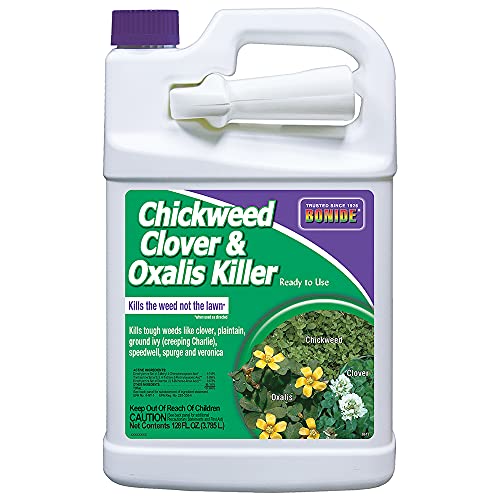 | Bonide Chickweed, Clover & Oxalis Killer (Ready-to-Use)Best for Spot Spraying | Check price |
| 4 | 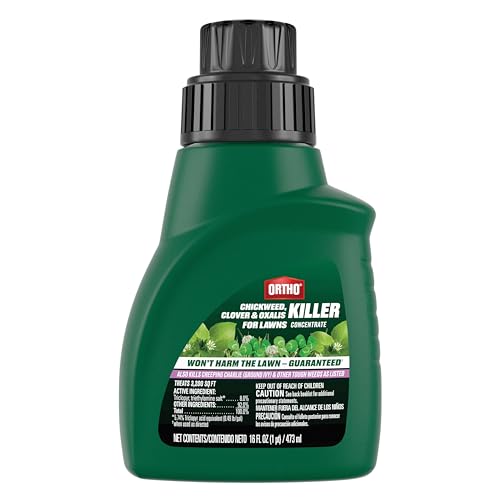 | Ortho Chickweed, Clover & Oxalis Killer ConcentrateBest for Cool-Season Lawns | Check price |
| 5 |  | Spectracide Weed Stop for Lawns Plus Crabgrass KillerBest All-in-One | Check price |
| 6 |  | Scotts Turf Builder Weed & Feed3Best Granular (Feed + Weed) | Check price |
The best clover killers for lawns
1Fertilome Weed Free ZoneBest Overall
Weed Free Zone combines triclopyr and clopyralid, two of the most effective lawn-safe ingredients against clover. It controls 80+ broadleaf weeds including spurge, chickweed and thistle. Injury shows within hours, and it’s labeled safe on Kentucky bluegrass, Bermuda, Bahia, zoysia and more.
- Active ingredients: triclopyr + clopyralid (plus others, see label)
- Weeds: 80+ broadleaf, including clover
- Grass safety: Kentucky bluegrass, Bermuda, Bahia, zoysia and more (see label)
- Form: 16 oz concentrate
Best For: Stubborn clover in most cool- and warm-season lawns.
Pros:
- Strong clover chemistry
- Fast visible results
- Concentrate goes a long way
Cons:
- Check your grass type on the label
- Stock varies
- Needs a tank sprayer
2Bonide Chickweed, Clover & Oxalis Killer (Concentrate)Best Value
Bonide’s concentrate kills clover, chickweed, oxalis, dandelion, ground ivy and 100+ other weeds roots and all, without killing lawn grass when used as directed. It’s an inexpensive way to treat a whole lawn.
- Weeds: 100+ broadleaf, including clover and oxalis
- Form: 16 oz concentrate
- Apply: when weeds are actively growing, in mild temperatures
Best For: Budget whole-lawn clover control.
Pros:
- Low cost per square foot
- Broad weed list
- Kills roots
Cons:
- Mixing required
- Check grass type on the label
- May need a repeat application
3Bonide Chickweed, Clover & Oxalis Killer (Ready-to-Use)Best for Spot Spraying
The same formula in a 128 oz ready-to-use sprayer. Nothing to mix, so it’s ideal for clover patches and edges.
- Form: 128 oz ready-to-use spray
- Weeds: clover, chickweed, oxalis, dandelion and more
Best For: Patches and spot treatments.
Pros:
- No mixing
- Big bottle
- Precise application
Cons:
- Expensive for whole lawns
- Trigger spraying is slow
- Grass-type limits apply
4Ortho Chickweed, Clover & Oxalis Killer ConcentrateBest for Cool-Season Lawns
Ortho’s concentrate treats up to 3,200 sq ft per 16 oz. It’s labeled for buffalograss, fescues, Kentucky bluegrass, ryegrass and zoysiagrass. Apply below 90°F with a tank sprayer.
- Coverage: up to 3,200 sq ft per 16 oz
- Grass safety: buffalograss, fescues, Kentucky bluegrass, ryegrass, zoysia
- Apply: below 90°F
Best For: Fescue, bluegrass and ryegrass lawns.
Pros:
- Clear grass-type labeling
- Kills to the root
- Well-known brand
Cons:
- Not listed for St. Augustine or centipede
- Limited stock
- Concentrate only
5Spectracide Weed Stop for Lawns Plus Crabgrass KillerBest All-in-One
If you have clover plus crabgrass, nutsedge and dandelions, Spectracide’s concentrate controls 470+ listed weeds, including clover and crabgrass. It’s rainproof 3 hours after application, and 32 oz treats up to 5,000 sq ft.
- Weeds: 470+ listed, including clover, crabgrass and yellow nutsedge
- Rainproof: 3 hours
- Coverage: up to 5,000 sq ft per 32 oz
Best For: Lawns with mixed broadleaf and grassy weeds.
Pros:
- Very broad weed list
- Cheap
- Quick rainfastness
Cons:
- Clover may need a second pass
- Check grass-type restrictions
- Concentrate needs a sprayer
6Scotts Turf Builder Weed & Feed3Best Granular (Feed + Weed)
Scotts’ latest Weed & Feed claims up to 2× stronger dandelion and clover control than its previous formula, and it fertilizes at the same time. Apply it to damp grass so the granules stick to the weed leaves.
- Form: granular weed and feed
- Targets: dandelion and clover (plus listed weeds)
- Size: 14.29 lb
Best For: Owners who prefer a spreader to a sprayer, and lawns that need feeding.
Pros:
- Feeds and weeds in one pass
- No mixing
- Thickens turf to crowd out clover
Cons:
- Needs damp leaves to work
- Not for St. Augustine and some warm-season grasses (see label)
- Less precise than spot spraying
How to kill clover for good
- Identify your grass and choose a product labeled safe for it.
- Spray in spring or fall, when clover is actively growing and it’s below about 85–90°F. Don’t spray a drought-stressed lawn.
- Don’t mow for a couple of days before and after, so there’s leaf to absorb the spray.
- Repeat after the label’s waiting period if regrowth appears.
- Feed the lawn. Clover thrives in low-nitrogen soil. Regular fertilizing and mowing at the right height help the grass crowd it out.
Frequently asked questions
What kills clover but not grass?
Selective broadleaf herbicides, especially those containing triclopyr, often combined with clopyralid, 2,4-D, MCPP or dicamba. Always confirm your grass species is listed on the label.
How long does it take to kill clover?
Curling and yellowing often show within days. Full kill can take 2–3 weeks, and a second application is sometimes needed.
Is clover bad for my lawn?
Not really. It adds nitrogen and feeds pollinators, and some people now seed it on purpose. If you remove it, mow before blooms open to protect bees.
Does vinegar kill clover?
Strong vinegar burns the leaves but also the grass, and clover usually regrows from the roots. It isn’t a selective lawn solution.
How we chose: This is a researched guide. We compared active ingredients, weed lists, grass-type safety, coverage and form from product labels, plus extension guidance on broadleaf weed control. We didn’t field-test these products. Always follow the label for your grass type and temperature limits.
Update log: November 2026: rebuilt the guide. We removed duplicate and vinegar products, focused on clover-effective chemistry, added grass-type notes, a step-by-step plan and an FAQ.