
Quick answer
A replacement lawn mower engine has to match your old one on three things: vertical shaft (almost all mowers), crankshaft diameter × length (for example 7/8″ × 3-5/32″ on push mowers, 1″ × 3-5/32″ on many riders), and mounting and controls. For push mowers our pick is the Briggs & Stratton 163cc (104M02-0197). For riding mowers, the Briggs 20 HP Intek V-twin is the value pick and the Kawasaki 24 HP V-twin is the premium choice.
When an engine has a thrown rod, scored cylinder or bad crank, a new engine is often cheaper than a rebuild. Many mower decks and frames outlast several engines. The catch is fit. Lawn mowers use vertical-shaft engines (the crankshaft points down at the blade), and the shaft size, bolt pattern, controls and electrical connections must all match.
| 1 |  | Briggs & Stratton 163cc 7.25 TP (104M02-0197)Best for Push Mowers | Check price |
| 2 |  | Briggs & Stratton Professional Series 19 HP 540ccBest Single-Cylinder for Riders | Check price |
| 3 |  | Briggs & Stratton 20 HP Intek V-Twin (40N777)Best Value V-Twin | Check price |
| 4 | 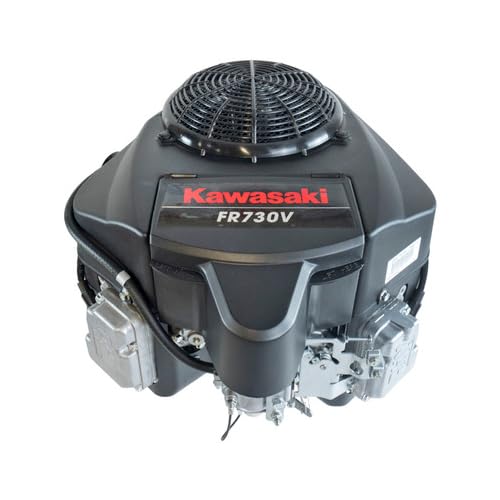 | Kawasaki 24 HP 726cc V-TwinBest Premium V-Twin | Check price |
| 5 |  | Kohler 7000 Pro Series 26 HP (KT745)Best for Larger Zero-Turns | Check price |
The best replacement lawn mower engines
1Briggs & Stratton 163cc 7.25 TP (104M02-0197)Best for Push Mowers
This is the standard Briggs walk-behind engine: 163 cc, a 7/8″ × 3-5/32″ keyed crankshaft, and a flywheel brake system made for push mowers. The throttle is fixed at about 3,100 RPM, typical for a walk-behind. Note that it’s built only for mowers, not pressure washers or edgers.
- Displacement: 163 cc
- Shaft: 7/8″ × 3-5/32″, keyed, vertical
- Speed: fixed, about 3,100 RPM
- Brake: flywheel brake (for push mowers)
- Mounting: drilled holes; reuse your bolts
Best For: 21–22″ push and self-propelled mowers with a 7/8″ shaft.
Pros:
- Common size that fits many decks
- Briggs parts and service everywhere
- Flywheel brake for mower safety
Cons:
- Mowers only
- Check your self-propel drive pulley fits the shaft
- Controls must match your handle cable
2Briggs & Stratton Professional Series 19 HP 540ccBest Single-Cylinder for Riders
For lawn tractors that came with a single-cylinder engine, this Professional Series 540 cc has full-pressure lubrication with an oil filter, a pulse fuel pump, an OHV design and a 9-amp charging system. Those are upgrades over many original-equipment singles.
- Power: 19 HP, 540 cc, single cylinder
- Lubrication: full pressure with oil filter
- Fuel: pulse fuel pump
- Charging: 9 A
- Shaft: vertical; confirm size before ordering
Best For: Lawn tractors with a single-cylinder engine.
Pros:
- Oil filter and pressure lube for longer life
- Pro-series build
- Good charging output
Cons:
- Confirm shaft length for your PTO clutch
- Single cylinder vibrates more than a twin
- Install takes a few hours
3Briggs & Stratton 20 HP Intek V-Twin (40N777)Best Value V-Twin
A common repower for consumer lawn tractors and zero-turns. The 656 cc Intek V-twin has a 1″ × 3-5/32″ shaft and a 9-amp charging system. Briggs makes several shaft lengths, so measure yours.
- Power: 20 HP, 656 cc V-twin
- Shaft: 1″ × 3-5/32″
- Charging: 9 A
- Use: riding mowers and zero-turns
Best For: Tractors and residential zero-turns with a 1″ × 3-5/32″ shaft.
Pros:
- Smooth V-twin power
- Fair price for a twin
- Widely supported
Cons:
- Wrong shaft length means a costly return
- Wiring and throttle may need adapting
- Heavier than a single
4Kawasaki 24 HP 726cc V-TwinBest Premium V-Twin
Kawasaki’s 726 cc OHV V-twin is known for durability in residential and light-commercial mowers. This version has a 1″ × 3-5/32″ shaft (tapped 7/16″, ¼″ keyway), a fuel pump and electric start.
- Power: 24 HP, 726 cc OHV V-twin
- Shaft: 1″ × 3-5/32″, tapped 7/16″, ¼″ key
- Features: fuel pump, electric start
Best For: Owners who want a long-lasting upgrade.
Pros:
- Reputation for durability
- Strong torque
- Fuel pump included
Cons:
- Expensive
- Stock can be limited
- Measure the shaft carefully
5Kohler 7000 Pro Series 26 HP (KT745)Best for Larger Zero-Turns
Kohler’s 747 cc 7000 Pro Series twin uses a longer 1-1/8″ × 4-5/16″ shaft common on bigger zero-turns and garden tractors. It suits machines that originally had a Kohler 7000.
- Power: 26 HP, 747 cc V-twin
- Shaft: 1-1/8″ × 4-5/16″, tapped 7/16″, ¼″ key
- Series: Kohler 7000 Pro
Best For: Larger zero-turns and garden tractors with this shaft size.
Pros:
- High power for big decks
- Pro-series build
- Direct fit for many Kohler 7000 machines
Cons:
- Premium price
- Long shaft won’t suit most lawn tractors
- Limited stock
How to choose a replacement engine
Shaft
Measure the diameter and length from the mounting face. Common sizes: 7/8″ × 3-5/32″ (push), 1″ × 3-5/32″, 1-1/8″ × 3.94″ or 4-5/16″ (riders).
Mounting
The bolt pattern must match the deck or frame. Most use a standard pattern, but check.
Power
Match or slightly exceed the original. Too much power can overload belts and transmissions.
Controls & wiring
Throttle and choke cables, the brake (push mowers), the starter, charging output and the safety interlocks must all connect.
Engine swap tips
- Photograph the throttle, choke and wiring connections before removing the old engine.
- Move the blade adapter, pulleys and PTO clutch to the new engine and torque them to spec.
- Fill the new engine with the correct oil before starting. Most ship dry.
- Check that the safety interlocks (seat, brake, PTO) still stop the engine.
Frequently asked questions
Is it worth replacing a lawn mower engine?
For a riding mower with a sound deck, frame and transmission, usually yes. A new engine costs far less than a new tractor. For a cheap push mower, a new mower may cost about the same as an engine.
Can I put a horizontal-shaft engine on a mower?
Not on a standard rotary mower. The blade mounts on a vertical shaft. Horizontal engines (like 212 cc go-kart engines) are for pumps, generators and some reel or specialty mowers.
How do I find my engine’s model number?
It’s stamped on the engine shroud or valve cover. Briggs uses a model/type/code set, Kohler a model and spec number. That number gives the exact shaft and fit details.
How we chose: This is a researched guide. We compared crankshaft dimensions, displacement, lubrication, charging and fit notes from manufacturer listings and replacement-engine guidance. We didn’t field-test these engines. Measure your old engine and confirm with the engine model number before ordering.
Update log: November 2026: rebuilt the guide. We removed horizontal-shaft engines that don’t fit mowers, organized picks by push mower and riding mower, and added shaft sizing, swap tips and an FAQ.