
Quick answer
If you own an angle grinder, the SporGain blade sharpener jig is the best mix of speed, accuracy and price. It holds the blade at a fixed angle so every edge comes out the same. On a tight budget, the Arnold BSK-1 drill sharpener kit sharpens and balances for about the cost of a single new blade. Whatever you use, balance the blade afterwards.
A dull mower blade tears grass instead of cutting it. The ragged tips turn brown within a day or two and give disease an easy way in. Most homeowners should sharpen at least once a season, more often if they mow sandy ground or hit sticks and roots. The tool you need depends on how many blades you sharpen and what’s already in your garage.
| 1 | 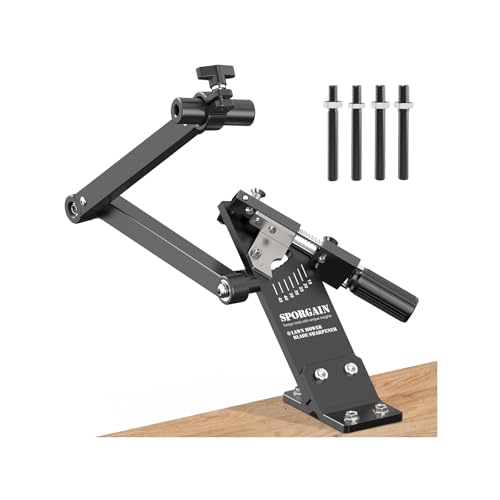 | SporGain Blade Sharpener JigBest Overall | Check price |
| 2 |  | All American Sharpener 5005 Gen 2Best for Heavy Use | Check price |
| 3 |  | Arnold BSK-1 Sharpener & Balancer KitBest Budget Kit | Check price |
| 4 |  | Oregon 514363 Drill Blade SharpenerBest Drill Attachment | Check price |
| 5 |  | Smith’s 50603 Handheld SharpenerBest Manual Option | Check price |
| 6 |  | Nicholson 10″ Mill Bastard FileBest Hand File | Check price |
| 7 | 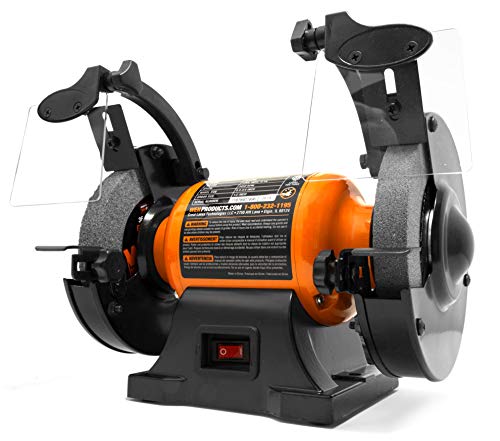 | WEN BG4260 6″ Bench GrinderBest Bench Grinder Value | Check price |
| 8 |  | Oregon Universal Blade BalancerBest Add-On | Check price |
The best lawn mower blade sharpeners
1SporGain Blade Sharpener JigBest Overall
The SporGain is a bench-mounted frame that holds your angle grinder and the blade at a set angle. That solves the main problem with freehand sharpening: an uneven bevel. You clamp the blade, set the angle once with thumb screws, and sweep the grinder along the edge. Repeat it on the other end, or on the next blade, without re-measuring.
- Type: angle-grinder jig
- Angle: adjustable 15°–45°
- Blade width: 1.65″–3.60″
- Blades: standard, mulching, high-lift
- Needs: your own angle grinder and a bench
Best For: Homeowners with an angle grinder who want consistent, pro-style edges.
Pros:
- Repeatable angle on every blade
- Fits most angle grinders with the included adapter screws
- Much cheaper than the American-made original
Cons:
- Grinder not included
- Takes 10–15 minutes to set up the first time
- Needs to be bolted or clamped to a solid bench
2All American Sharpener 5005 Gen 2Best for Heavy Use
This is the original design the SporGain and other jigs copy, made in the USA with a lifetime warranty. The bundle includes a blade balancer that handles star-shaped and other odd center holes. It’s overkill for one push mower, but if you sharpen blades for a zero-turn, a tractor and the neighbors’ mowers, the heavier build pays off.
- Type: angle-grinder jig with balancer
- Blades: standard, mulching, high-lift
- Balancer holes: ½″–1¼″, including star shapes
- Warranty: lifetime
- Made in: USA
Best For: Owners of riding mowers, zero-turns or several mowers; small landscaping crews.
Pros:
- Rugged build and lifetime warranty
- Balancer included
- Portable when paired with a cordless grinder
Cons:
- About five times the price of the copies
- Grinder still not included
- More tool than an occasional user needs
3Arnold BSK-1 Sharpener & Balancer KitBest Budget Kit
Arnold’s kit pairs a drill-powered grinding stone with a simple cone balancer. The stone’s guide rests against the back of the blade so the bevel stays roughly correct. It’s slower and less precise than a grinder jig, but it fits any 1/4″ or 3/8″ drill and costs about the same as a replacement blade.
- Type: drill attachment + static balancer
- Fits: 1/4″ and 3/8″ drill chucks
- Mowers: walk-behind, tractor and zero-turn blades
- In the box: 1 sharpener, 1 balancer
Best For: Once- or twice-a-season sharpening with a drill you already own.
Pros:
- Very cheap
- Includes the balancer you need anyway
- No bench or grinder required
Cons:
- Stone wears down over a few seasons
- Struggles with nicks and badly rounded edges
- Plastic cone balancer is basic
4Oregon 514363 Drill Blade SharpenerBest Drill Attachment
If you already have a balancer, Oregon’s drill sharpener is the same idea as Arnold’s from the biggest name in mower parts. You chuck it into a 1/4″ or 3/8″ drill, rest the guide on the blade and run it along the cutting edge a few times.
- Type: drill-mounted grinding stone
- Fits: 1/4″ and 3/8″ drills
- Part no.: 514363
- Weight: about 4 oz
Best For: Touch-ups between deeper sharpenings.
Pros:
- Trusted brand, low price
- Fast on lightly dulled blades
- Small enough to keep in a drawer
Cons:
- No balancer in the box
- Not for reshaping damaged blades
- Easy to overheat the edge if you press hard
5Smith’s 50603 Handheld SharpenerBest Manual Option
No power tools at all. Smith’s handheld uses a preset carbide cutter that you draw along the blade a few times. The oversized handle and big finger guard make it usable with gloves on. It won’t fix a chewed-up edge, but it restores a clean cut on a blade that’s just gone dull.
- Type: handheld carbide sharpener
- Size: 7″ × 2.75″
- Cutter: replaceable carbide
- Extras: wire cleaning brush in the handle
Best For: Quick mid-season touch-ups with no power tools.
Pros:
- Nothing to plug in or set up
- Safety guard and glove-friendly handle
- Replaceable cutter
Cons:
- Slow on very dull blades
- Preset angle may not match every blade
- Blade still has to come off the mower
6Nicholson 10″ Mill Bastard FileBest Hand File
Many mower techs still finish blades with a plain mill file, because it removes metal slowly and can’t overheat the steel. A 10″ single-cut bastard file is the standard size. Clamp the blade in a vise, follow the existing bevel and push the file one way only, away from you.
- Type: mill file, single cut
- Cut: bastard (medium-coarse)
- Length: 10″
- Handle: included
Best For: Careful owners who want full control and zero risk of burning the edge.
Pros:
- Cannot overheat or soften the blade
- Lasts for years
- Cheapest way to get a good edge
Cons:
- Slowest method here
- Needs a bench vise
- Takes practice to hold a steady angle
7WEN BG4260 6″ Bench GrinderBest Bench Grinder Value
A bench grinder handles badly nicked blades that drill stones can’t fix, and it sharpens chisels, axes and shovels too. WEN’s 6-inch model ships with a coarse 36-grit wheel for reshaping and a 60-grit wheel for finishing. The tool rests and eye guards are adjustable.
- Type: 6″ bench grinder
- Motor: 2.1 A, up to 3,450 RPM
- Wheels: 36-grit and 60-grit
- Warranty: 2 years
Best For: Nicked or damaged blades, and a garage that sharpens more than mower blades.
Pros:
- Removes nicks quickly
- Useful for every garden tool
- Affordable for a bench grinder
Cons:
- Freehand, so the angle depends on your skill
- Overheats the edge easily; dip the blade in water often
- Needs to be bolted down
8Oregon Universal Blade BalancerBest Add-On
Not a sharpener, but don’t skip it. Sharpening removes metal unevenly, and an unbalanced blade shakes the mower, wears out the spindle bearings and can crack the deck. Oregon’s die-cast cone balancer sits on any flat surface. If one end of the blade drops, you take a little more off that end until it hangs level.
- Type: static cone balancer
- Material: zinc die-cast
- Fits: push, riding and zero-turn rotary blades
Best For: Anyone who sharpens blades. Use it every time.
Pros:
- Protects the engine and spindles from vibration
- Also shows if a blade is bent
- Metal, not plastic
Cons:
- Cone may not center on unusual hole shapes
- Doesn’t sharpen anything on its own
How to choose a blade sharpener
Grinder jigs
Most accurate and fast. Best if you own an angle grinder or sharpen several blades a season.
Drill attachments
Cheapest powered option. Good for lightly dull blades and touch-ups, not damaged edges.
Files and handhelds
Slow but safe for the steel. Great for quick touch-ups and careful owners.
Bench grinders
Fix nicks and rounded edges fast, but freehand. Keep the blade cool.
How to sharpen a mower blade safely
- Disconnect the spark plug wire (or remove the battery on electric mowers) so the engine can’t start.
- Tip the mower with the air filter and carburetor facing up, so oil and fuel don’t leak into them.
- Mark the bottom of the blade with paint or marker so it goes back the right way up.
- Lock the blade and remove the bolt. A wood block or a blade removal tool stops it turning. Wear heavy gloves.
- Sharpen only the cutting edge, along the existing bevel. Most blades sit roughly between 30° and 40°. Aim for a “butter-knife” edge, not razor-sharp.
- Keep the steel cool. If the edge turns blue, it has lost its hardness. Dip the blade in water often when using power tools.
- Balance the blade, then reinstall it marked side down and tighten the bolt to the torque in your manual.
When to replace instead of sharpen
- The blade is bent, even slightly. The balancer often reveals this.
- There are cracks, especially near the center hole or where the lift wing meets the blade.
- The lift “wings” at the back are worn thin. Bagging and mulching will suffer.
- Repeated sharpening has made the blade noticeably narrower.
Frequently asked questions
How often should I sharpen my mower blade?
A common rule of thumb is every 20–25 hours of mowing. For most homeowners that means once or twice a season. Sharpen sooner if grass tips look shredded or turn brown a day after mowing, or after hitting rocks or roots.
What angle should a lawn mower blade be sharpened at?
Follow the factory bevel already on the blade. Most fall roughly between 30° and 40°. Jigs like the SporGain let you match it exactly. Too steep an angle makes a thin edge that dulls and chips quickly.
Can I sharpen the blade without taking it off?
You can touch it up in place with a file, but it isn’t recommended. You can’t balance the blade, it’s awkward to hold a steady angle, and the risk of injury is higher. Removing the blade usually takes five minutes.
Do drill-bit sharpeners actually work?
Yes, for blades that are only dull. They’re slower and less precise than a grinder jig and won’t remove deep nicks. Run the drill at moderate speed and use light pressure so you don’t overheat the edge.
Is it worth paying a shop to sharpen blades?
Shops typically charge a few dollars to around $15 per blade. If you sharpen more than once a year, even the cheapest kit here pays for itself after one or two sessions.
How we chose: This is a researched guide. We compared manufacturer specs (angle range, blade compatibility, included parts and warranty), current Amazon listings, and standard mower-maintenance practice from owner’s manuals. We didn’t field-test these products. Prices and availability change, so check the current listing.
Update log: November 2026: rebuilt the guide. We replaced duplicate drill stones with one pick per sharpening method, added a blade balancer, a step-by-step safety guide, replace-vs-sharpen advice and an FAQ.