
Quick answer
A lawn leveling rake, a flat mesh head on a long handle, is the main tool for smoothing a bumpy lawn. You spread a thin topdressing of sand or soil mix and push it into the low spots. Our top pick is the Dremmt 30″ × 10″ stainless leveling rake with a 72″ handle. Big lawns go faster with a tow-behind drag mat. Keep each layer to about ¼–½ inch so the grass can grow through.
Bumpy lawns scalp when you mow and look patchy. Most unevenness is shallow dips and humps, which you fix by topdressing gradually, not by rolling. A heavy roller compacts the soil and rarely removes bumps. The tools below help you spread and work the topdressing evenly.
| 1 |  | Dremmt Lawn Leveling Rake 30″ × 10″Best Overall | Check price |
| 2 | | Dremmt Lawn Leveling Rake 45″ × 10″Best for Larger Lawns | Check price |
| 3 | 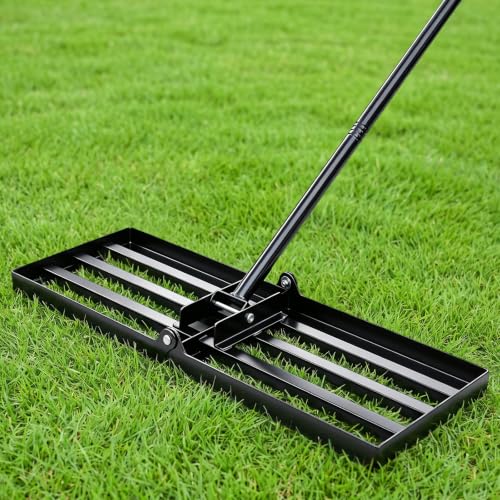 | Sakerplus 30″ Leveling RakeBest Budget | Check price |
| 4 | 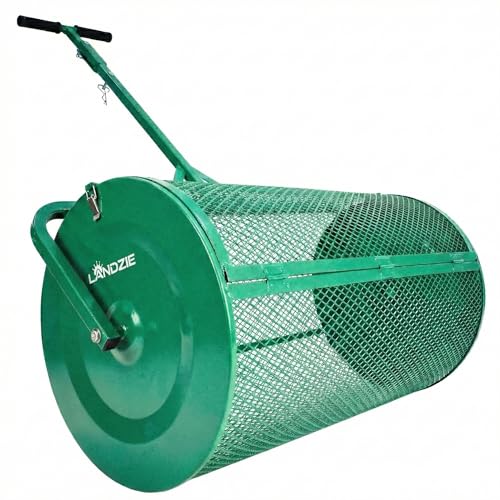 | Landzie 36″ Compost & Peat Moss SpreaderBest for Spreading Topdressing | Check price |
| 5 |  | Yard Tuff Leveling Drag MatBest Tow-Behind | Check price |
| 6 |  | VINGLI 24″ Water-Filled Lawn RollerBest for Seed and Sod Contact | Check price |
The best lawn leveling tools
1Dremmt Lawn Leveling Rake 30″ × 10″Best Overall
A 30″ × 10″ stainless steel leveling head on a long 72″ handle, so you can work standing upright. The flat head drags topdressing off the high spots and into the dips instead of bouncing over them.
- Head: 30″ × 10″ stainless steel
- Handle: 72″
- Use: spreading and leveling topdressing
Best For: Most lawns and most leveling jobs.
Pros:
- Good size for control and coverage
- Long handle saves your back
- Rust-resistant head
Cons:
- Manual effort on big lawns
- Bulky to store
- Not for moving lots of material
2Dremmt Lawn Leveling Rake 45″ × 10″Best for Larger Lawns
The same design with a 45″ head, so it covers 50% more per stroke. It’s best for open lawns and experienced levelers.
- Head: 45″ × 10″ stainless steel
- Handle: 72″
Best For: Big, open lawns.
Pros:
- Fewer passes
- Smooth, wide finish
- Durable
Cons:
- Heavier to push with wet sand
- Harder around beds and trees
- Pricier
3Sakerplus 30″ Leveling RakeBest Budget
A 30″ × 10″ stainless plate on a 73″ fixed handle, at a lower price. It’s a good choice for a one-off leveling job.
- Head: 30″ × 10″ stainless steel
- Handle: 73″ fixed
Best For: Occasional or one-time leveling.
Pros:
- Low price
- Long fixed handle
- Same useful 30″ width
Cons:
- Less refined build
- Fixed handle can’t be shortened
- Basic finish
4Landzie 36″ Compost & Peat Moss SpreaderBest for Spreading Topdressing
Before you level, you need to spread the material evenly. Landzie’s 36″ mesh-basket roller lays down compost, peat or a soil mix far more evenly than shovelling. You can push it or tow it.
- Width: 36″
- Mesh: diamond slits, ½″ × ¾″
- Use: push or tow
Best For: Spreading compost or soil-mix topdressing.
Pros:
- Very even spread
- Saves hours of shovelling
- Push or tow
Cons:
- Coarse or wet material can clog it
- Not for pure sand in all conditions
- Big to store
5Yard Tuff Leveling Drag MatBest Tow-Behind
Pulled behind a riding mower or ATV, a steel-mesh drag mat works topdressing into low spots across big areas quickly. It has a zinc-plated finish to resist rust.
- Build: heavy-duty zinc-plated steel mesh
- Use: towed by a mower, ATV or UTV
Best For: Large lawns, ball fields and gravel paths.
Pros:
- Very fast on big areas
- Durable
- Also levels gravel
Cons:
- Less precise than a rake
- Needs a towing vehicle
- Can pull up seedlings
6VINGLI 24″ Water-Filled Lawn RollerBest for Seed and Sod Contact
Rolling doesn’t remove real bumps and can compact clay soils. Its proper use is light rolling after seeding or laying sod, to press seed or sod into good contact with the soil. Fill with water for a lighter roll, or sand for more weight.
- Width: 24″
- Capacity: 13 gallons (water or sand)
- Use: push or tow
Best For: Pressing in new seed or sod.
Pros:
- Cheap
- Adjustable weight
- Push or tow
Cons:
- Doesn’t level bumps
- Can compact soil if overused
- Not for wet ground
How to level a lawn with topdressing
- Choose your timing. Level during active growth: late spring to summer for warm-season grass, early fall or spring for cool-season.
- Mow low and dethatch or aerate if needed, so the topdressing reaches the soil.
- Choose a material. Washed sand is common on warm-season lawns like Bermuda. On cool-season lawns, a sand, soil and compost mix is usually safer.
- Spread a thin layer, about ¼–½ inch, mostly over the dips.
- Work it in with the leveling rake, pushing and pulling until the grass blades poke through.
- Water lightly, then repeat in a few weeks for deeper dips. Fill deep holes (over about 1″) by cutting and lifting the sod and adding soil underneath.
Frequently asked questions
Does rolling a lawn level it?
Not really. Rolling only flattens the very top layer and can compact the soil. Topdressing and raking fixes the actual dips.
Sand or soil for leveling?
Sand drains well and doesn’t compact, which is great on sandy soils and warm-season lawns. On clay soils, mixing sand into clay can create drainage problems, so a soil and compost mix is often better. Ask your local extension office if unsure.
How thick can I topdress?
Keep each application to about ¼–½ inch so the grass isn’t smothered. Several thin layers beat one thick one.
How we chose: This is a researched guide. We compared head size, build, handle length and intended use from manufacturer listings, plus university extension guidance on topdressing and leveling. We didn’t field-test these tools.
Update log: November 2026: rebuilt the guide. We cut near-identical rakes, added a spreader, a drag mat and an honest note on rollers, plus a step-by-step leveling method and an FAQ.