
Quick answer
For a permanent sprinkler system fed by a shallow well, pond or lake, our top pick is the Red Lion RL-SPRK200. It’s a cast-iron 2 HP pump rated at up to 76 GPM, enough for roughly 10–21 sprinkler heads depending on the nozzles. For smaller systems, the AQUASTRONG 1.5 HP is the value pick. For portable watering from a rain barrel or pond, the Wayne PLS100 does the job. Size the pump to your zones’ gallons-per-minute, not to horsepower alone.
An irrigation pump lets you water your lawn from a well, pond, creek or cistern instead of city water. That can cut water bills sharply on big lawns. The pump has to deliver enough flow (GPM) at enough pressure (PSI) for the sprinklers in each zone, and it has to be able to lift water from your source.
| 1 |  | Red Lion RL-SPRK200 (2 HP)Best Overall | Check price |
| 2 |  | AQUASTRONG 1.5 HP Cast IronBest Value | Check price |
| 3 |  | Flotec 1.5 HP ThermoplasticBest Corrosion-Resistant | Check price |
| 4 | 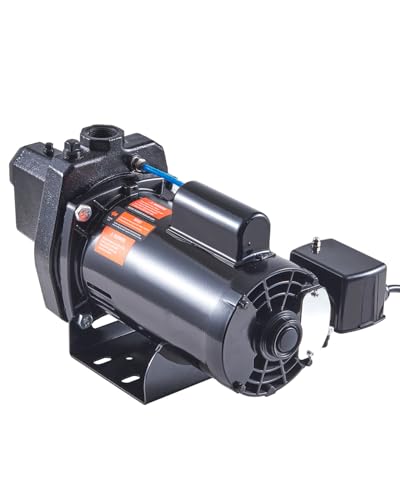 | VEVOR 1.5 HP Cast Iron with Pressure SwitchBest Budget | Check price |
| 5 |  | Wayne PLS100 1 HP PortableBest Portable Pump | Check price |
| 6 |  | Champion 2″ Gas Semi-Trash PumpBest Off-Grid Option | Check price |
The best lawn irrigation pumps
1Red Lion RL-SPRK200 (2 HP)Best Overall
Red Lion’s 2 HP sprinkler pump has a cast-iron housing and a glass-filled thermoplastic impeller for well or lake water. It’s rated at up to 76 GPM at 10 PSI and 64 GPM at 30 PSI, which Red Lion says handles up to 21 sprinkler heads with ½″ fittings. Once primed, it doesn’t need priming again.
- Power: 2 HP, 230 V, thermally protected
- Flow: up to 76 GPM at 10 PSI, 64 GPM at 30 PSI
- Housing: cast iron
- Impeller: glass-filled thermoplastic
Best For: Larger multi-zone sprinkler systems from a well or lake.
Pros:
- High flow for many heads
- Durable cast iron
- One-time priming
Cons:
- 230 V only
- Overkill for small systems
- Needs proper suction plumbing and a foot valve
2AQUASTRONG 1.5 HP Cast IronBest Value
A cast-iron 1.5 HP jet/centrifugal pump rated up to 4,250 GPH (about 70 GPM at low head) with a maximum head of 108 ft. It has a 2″ suction and 1½″ discharge, and runs on 115 or 230 V.
- Power: 1.5 HP, 115/230 V
- Flow: up to 4,250 GPH (max)
- Max head: 108 ft
- Ports: 2″ suction, 1½″ discharge
Best For: Mid-size sprinkler systems on a budget.
Pros:
- Strong flow for the price
- Dual voltage
- Cast-iron build
Cons:
- Max flow is at low pressure; check the curve for your PSI
- Brand support is newer than Red Lion’s
- Heavy
3Flotec 1.5 HP ThermoplasticBest Corrosion-Resistant
Flotec’s self-priming 1.5 HP sprinkler pump uses a fiberglass-reinforced thermoplastic housing that won’t rust. That’s a plus for pond, lake or slightly corrosive water. It’s rated up to 4,020 GPH.
- Power: 1.5 HP, 115/230 V
- Flow: up to 4,020 GPH
- Housing: reinforced thermoplastic
- Priming: self-priming after initial fill
Best For: Pond and lake water, or damp pump houses.
Pros:
- Won’t rust
- Self-priming
- Lighter than cast iron
Cons:
- Thermoplastic is less impact-resistant
- Slightly lower flow than cast-iron rivals
- Protect from freezing
4VEVOR 1.5 HP Cast Iron with Pressure SwitchBest Budget
VEVOR’s 1.5 HP pump includes a pressure switch that turns the pump on and off as valves open and close (20–40 PSI), so it can work like a booster. It lifts water up to 25 ft and is rated at 66 GPM.
- Power: 1.5 HP, 115/230 V
- Flow: 66 GPM rated
- Lift: up to 25 ft
- Control: pressure switch, 20–40 PSI
Best For: Budget systems that start and stop with the valves.
Pros:
- Built-in pressure switch
- Low price
- Dual voltage
Cons:
- Shorter track record
- Pressure-switch cycling needs a correctly sized system
- Basic documentation
5Wayne PLS100 1 HP PortableBest Portable Pump
For moving water from a rain barrel, pond or pool to a hose sprinkler, Wayne’s portable pump has a stainless steel housing, a carry handle and an on/off switch. It’s rated up to 850 GPH with up to 20 ft of suction lift, and includes a garden hose adapter.
- Power: 1 HP, 120 V, continuous duty
- Flow: up to 850 GPH
- Lift: up to 20 ft
- Ports: 1″ NPT, ¾″ hose adapter included
Best For: Hose-end watering from barrels, ponds or pools.
Pros:
- Portable
- Plugs into a normal outlet
- Corrosion-resistant housing
Cons:
- Too small for in-ground systems
- Needs priming
- Limited stock
6Champion 2″ Gas Semi-Trash PumpBest Off-Grid Option
No power at the pond? Champion’s 212 cc gas transfer pump moves up to 158 GPM and passes solids up to ½″. It comes with suction and discharge hoses and a wheel kit. It’s good for flood irrigation or filling tanks, but not for pressurized sprinkler systems.
- Engine: 212 cc Champion OHV
- Flow: up to 158 GPM
- Ports: 2″ NPT
- Solids: up to ½″
Best For: Remote ponds and moving large volumes without electricity.
Pros:
- Very high flow
- No power needed
- Complete hose kit
Cons:
- Low pressure, not for sprinkler heads
- Noise and fuel
- Needs supervision while running
How to size an irrigation pump
Flow (GPM)
Add up the GPM of every sprinkler head in your largest zone. The pump must supply that at your operating pressure.
Pressure (PSI)
Spray heads typically need about 30 PSI, rotors 40–50 PSI. Check the pump curve at that pressure.
Suction lift
Most centrifugal pumps lift about 20–25 ft. Deeper water needs a jet or submersible pump.
Power
230 V motors draw less current. Make sure your circuit and wire size match the pump.
Installation tips
- Use a foot valve and strainer on the suction line to keep the pump primed and stop debris getting in.
- Keep the suction line as short and straight as possible, and never smaller than the pump inlet.
- Protect the pump from freezing, and drain it for winter.
- Have a licensed electrician wire 230 V pumps, with GFCI protection where required.
Frequently asked questions
What size pump do I need for my sprinklers?
Match your largest zone’s total GPM at the pressure your heads need. As a rough guide, 1 HP suits small systems, 1.5 HP mid-size, and 2 HP larger multi-head zones.
Can I use pond water for my lawn?
Usually yes, with a good intake screen and foot valve. Check local water-use rules, and avoid water with heavy algae or salt.
Do I need a pressure tank?
Not for timer-controlled sprinkler systems where the pump runs during each zone. A pressure tank helps if the pump runs on demand from hose bibs, to prevent rapid cycling.
How we chose: This is a researched guide. We compared rated flow and pressure, suction lift, construction, voltage and priming from manufacturer listings, plus standard sprinkler pump sizing guidance. We didn’t field-test these pumps. Check each pump’s performance curve against your system, and use a licensed electrician for wiring.
Update log: November 2026: rebuilt the guide. We replaced unclear pumps with sized picks by use, added portable and gas options, a sizing guide, installation tips and an FAQ.